About the Author
Morgan Nicki Saatchi is co-owner of SVS Fine Jewelry, Long Island's Premier Jewelry Store, in Oceanside, NY since 2003. She and the SVS bridal team help couples compare diamond shapes side by side every day and have earned over 2,500 five-star Google reviews along the way.
The oval has been one of the most requested engagement ring shapes for years. So it makes sense that the newest shape everyone is asking about is an oval with a twist. The moval stretches the oval longer and slimmer and gives its ends a gentle taper borrowed from the marquise. If you love ovals but want something a little less expected, here is everything you need to know about a moval engagement ring, and exactly how it compares to a classic oval.
The Short Answer
A moval diamond is a hybrid of a marquise and an oval: longer and slimmer than a classic oval, with ends that taper gently but never come to a point. A classic oval usually has a length-to-width ratio of 1.30 to 1.50. A moval typically runs from about 1.60 to 2.10, with most falling between 1.70 and 1.85. Movals are cut in both natural and lab grown diamonds, and grading reports list them as oval brilliants.
Jump to a Section
What Is a Moval Diamond?
The name tells the story: marquise + oval = moval. A moval keeps the continuous curved outline and brilliant faceting of an oval, then draws the stone out longer and lets the ends narrow slightly, the way a marquise does. The difference is that a marquise ends in two sharp points, while a moval's ends stay softly rounded.
"Moval" is a cutter's name, not an official grading category. On a GIA, IGI or GSI report, a moval is simply listed as an oval brilliant. That means you cannot shop for a moval by the shape on the report. You have to look at the measurements, the ratio and, most importantly, the diamond itself.
Movals are cut in both natural and lab grown diamonds. Lab grown movals are widely available, and natural movals can be sourced by special order.
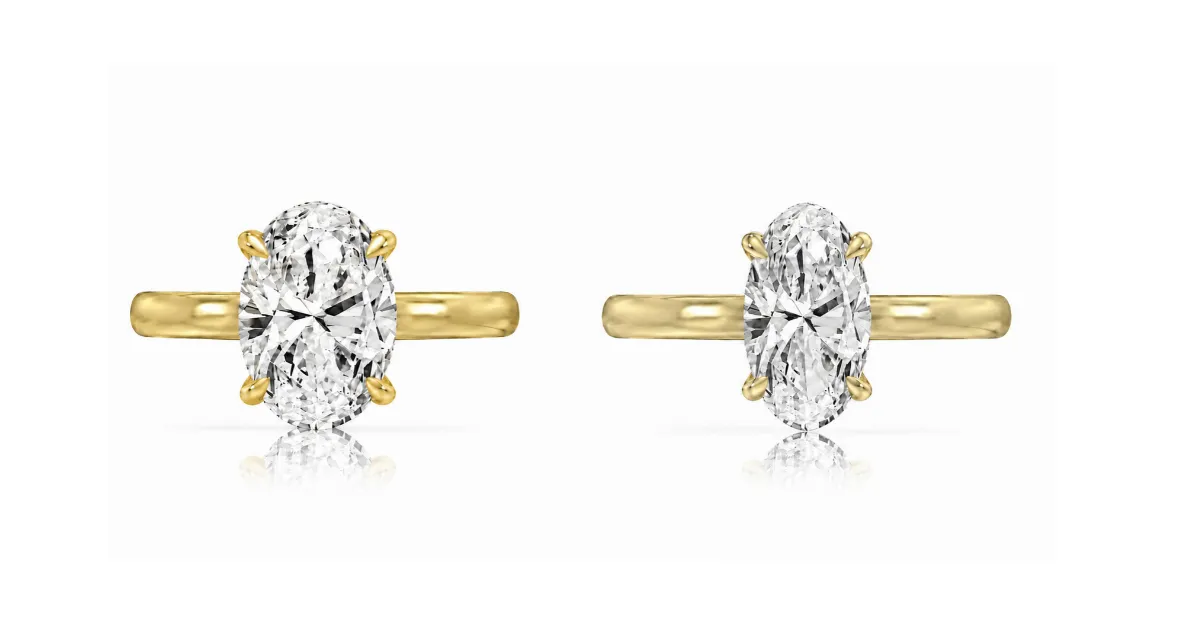
Moval vs. Oval Side by Side
| Classic Oval | Moval | |
| Length-to-width ratio | About 1.30 to 1.50 | About 1.60 to 2.10 (most 1.70 to 1.85) |
| Outline | Evenly rounded, egg-like | Long and lean, ends gently tapered |
| Ends | Round | Softly narrowed, never pointed |
| Finger coverage | Generous | Maximum length down the finger |
| Overall feel | Soft, balanced, timeless | Sleek, modern, a little dramatic |
| On the grading report | Oval brilliant | Oval brilliant |
At the same carat weight, a moval trades width for length. It looks longer on the hand, and because so much of the stone is spread along the finger, it often faces up larger than an oval of the same weight. One of the moval lab grown diamonds in our showroom weighs 2.51 carats and measures 12.96 by 6.86 mm, a 1.89 ratio. On the hand it reads like a much larger stone.
Moval and Oval Diamond Ratios
The length-to-width ratio is the stone's length divided by its width, and you can calculate it from the measurements on any grading report. For ovals and movals, it is the single biggest factor in how the diamond looks.
Oval diamond ratio
Most classic ovals fall between 1.30 and 1.50. Toward 1.30, the stone looks fuller and rounder. Toward 1.50, it looks noticeably longer and more elegant. Many of the couples we work with land in the middle of that range.
Moval ratio guide
1.60 to 1.70: softer. A fuller moval that still reads close to a long oval. A good choice if you want just a hint of the taper.
1.70 to 1.85: the sweet spot. The classic moval look, with graceful oval curves and gently tapered ends. This is where most movals are cut.
1.85 to 2.10: slender and dramatic. Long and lean, with a silhouette that leans toward the marquise and covers the most finger.
Elongated Oval or Moval?
You will also see "elongated oval" used for ovals at the long end of the range, around 1.50 to 1.60. The line between an elongated oval and a moval is not official, but here is the practical difference: an elongated oval keeps evenly rounded ends, while a moval's ends visibly narrow. If you want a long oval engagement ring that still looks unmistakably oval, ask for an elongated oval. If you want the taper, you are looking for a moval.
Which Shape Is Right for You?
Choose a classic oval if you love a soft, balanced shape that will never feel trendy, you want the widest choice of stones and settings, or you prefer a ring that looks substantial from every angle.
Choose a moval if you want an oval that feels fresh and a little unexpected, you love the length of a marquise but not the sharp points, or you want the most finger coverage for your carat weight.
Hand shape plays a part, too. Longer fingers carry a slim 1.90 moval beautifully. On shorter fingers, a moval in the 1.60 to 1.75 range or a classic oval often looks more balanced. The quickest way to know is to try both on.
Best Settings for a Moval Engagement Ring
Solitaire. A slim solitaire band lets the moval's length do all the talking. Four prongs show the most diamond; six prongs add security.
Hidden halo. A ring of small diamonds tucked under the center stone keeps the clean moval outline face up and adds sparkle from the side. Our 1.89 moval is set exactly this way.
Bezel. A thin rim of metal around the whole stone is sleek, modern and especially protective, which makes it a smart choice for active hands.
East-west. Turning a moval sideways across the finger is one of the most modern looks in bridal right now, and it works especially well on a stacked or minimalist band.
The Bow Tie: What to Look For
Ovals and movals can both show a bow tie, a darker shape across the center of the stone where less light returns to your eye. A light bow tie is normal and adds contrast. A heavy one makes the diamond look dull from across the room. Grading reports do not measure the bow tie, so the only way to judge it is to see the diamond in person, under different lighting and on your hand.
Love Unique Shapes?
See how the moval compares to the Dutch marquise and the elongated cushion in our Dutch Marquise, Moval and Elongated Cushion Guide, or start with the classics in our guide to the most popular diamond shapes.
Compare Them Side by Side at SVS
Photos flatten the very things that separate a moval from an oval: how far the ends taper, how the stone sits on your finger, how much bow tie shows. At a private bridal appointment, our team will put ovals and movals side by side so you can see the difference in seconds. If the right stone is not in the case, we can source a natural or lab grown moval and build a custom setting around it. Special-order ring sizes typically take 3 to 4 weeks.
Every SVS engagement ring comes with flexible financing and complimentary lifetime cleaning, backed by over 2,500 five-star Google reviews. Considering lab grown? Our Lab Grown Diamonds Buyer's Guide covers the basics.
Frequently Asked Questions
What is a moval diamond?
A moval is a hybrid of a marquise and an oval. It is longer and slimmer than a classic oval, with ends that taper gently but stay rounded. Grading reports list a moval as an oval brilliant because "moval" is a cutter's name, not a grading category.
What is the difference between a moval and an oval?
The ratio and the ends. A classic oval usually has a length-to-width ratio of 1.30 to 1.50 with evenly rounded ends. A moval typically runs 1.60 to 2.10 and its ends narrow slightly, giving it a longer, leaner look.
What is the best ratio for a moval diamond?
Most movals fall between 1.70 and 1.85, which gives the classic moval look. Ratios from 1.60 to 1.70 look softer and closer to an oval, while 1.85 to 2.10 looks slender and dramatic.
Do movals come in natural diamonds?
Yes. Movals are cut in both natural and lab grown diamonds. Lab grown movals are widely available, and natural movals can be sourced by special order.
Where can I see moval engagement rings on Long Island?
SVS Fine Jewelry in Oceanside, NY carries moval and oval lab grown diamonds and can source natural movals by special order. Book a private bridal appointment to compare them side by side.
Long Island's Premier Jewelry Store
Oval or Moval? See Both on Your Hand
Book a private bridal appointment at our Oceanside showroom and compare ovals and movals side by side with our bridal team.
| Book Bridal Appointment | Shop Lab Grown Rings |
SVS Fine Jewelry · 3323 Long Beach Road, Oceanside, NY 11572 · (516) 766-2614 · Locally owned, locally loved, since 2003