About the Author
Morgan Nicki Saatchi is co-owner of SVS Fine Jewelry, Long Island's Premier Jewelry Store, in Oceanside, NY since 2003. She and the SVS bridal team hand-select every lab grown diamond in the showroom, including the unusual shapes in this guide, and have earned over 2,500 five-star Google reviews along the way.
Round, oval and emerald will always have their place. But more and more of the couples who sit down at our bridal counter want a center stone that nobody else in the group chat has. Three shapes keep coming up: the Dutch marquise, the moval and the elongated cushion. Each one takes a familiar outline and stretches it into something new. Here is what each shape actually is, how to read its proportions, and which settings bring it to life.
The Short Answer
A Dutch marquise diamond is a six-sided, elongated hexagonal cut: a marquise with straight sides and softened tips instead of sharp points. A moval diamond is a hybrid of a marquise and an oval, slimmer than a classic oval with gently tapered ends. An elongated cushion cut diamond is a rectangular cushion with rounded corners and a length-to-width ratio of roughly 1.20 or more. All three are cut in both natural and lab grown diamonds, and all three make a center stone look longer and larger on the finger than a round of the same carat weight.
Jump to a Section
What Is a Dutch Marquise Diamond?
Picture a classic marquise, the long boat shape with a sharp point at each end. Now straighten its curved sides into two long, flat edges and let each end come to a point from two short facets instead of one fine tip. That six-sided outline is the Dutch marquise. It reads as long, slim and architectural, with the clean lines of a step cut and much of the sparkle of a brilliant.
"Dutch marquise" is a trade name, not a grading category, so you will not see those words on a lab report. Grading labs typically describe the shape as a modified hexagon, and you will also hear it called an elongated hexagon. The difference between the two names is mostly proportion and faceting: a Dutch marquise is usually slimmer and more pointed at the ends, while "elongated hexagon" is often used for flatter-ended, step-cut versions. When you shop, look at the outline and the ratio rather than the label.
Why couples choose a Dutch marquise engagement ring
It looks bigger. Because so much of the weight is spread across the length of the stone, a Dutch marquise faces up larger than most shapes of the same carat weight.
It elongates the finger. A stone with a length-to-width ratio near 2.00 runs right down the finger, which is the most flattering line you can give a hand.
Its tips are sturdier. The ends of a traditional marquise taper to a fine point that needs protection. The Dutch marquise ends are built from two short facets, so there is a little more diamond at each tip.
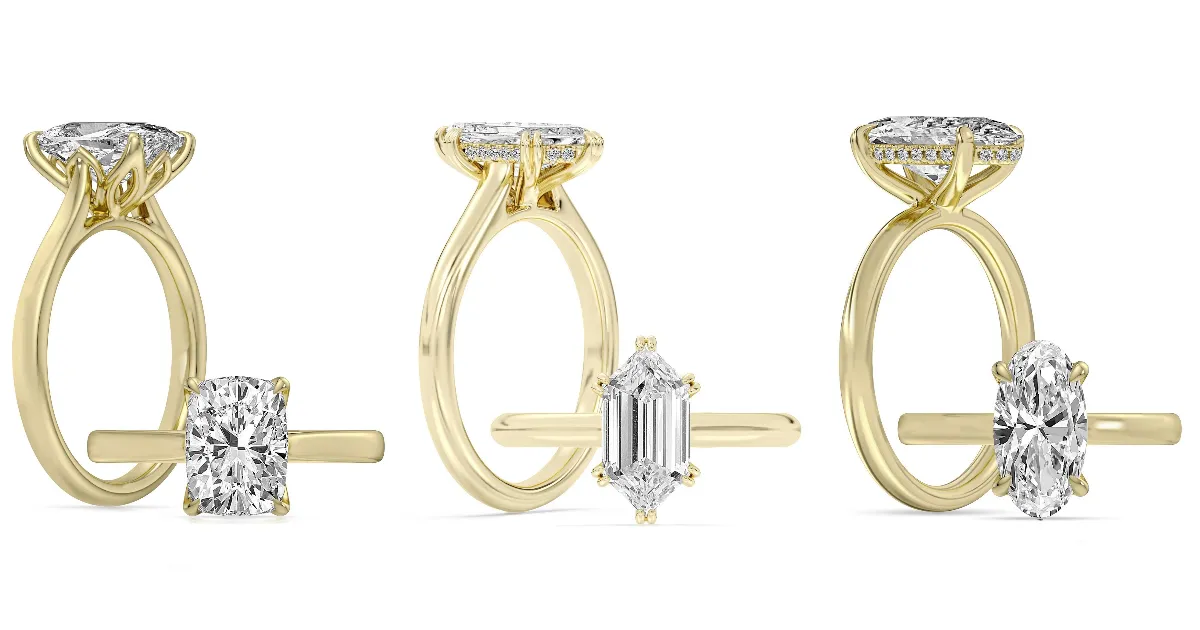
The Dutch marquise lab grown diamonds we have hand-selected for our showroom sit right around a 2.00 ratio, set both in a sleek full bezel and over a hidden halo. If you love the drama of a marquise but want something more modern, this is the shape to try on first.
Moval vs. Oval: What Is a Moval Diamond?
The name says it: marquise + oval = moval. A moval diamond keeps the soft, continuous curves and brilliant sparkle of an oval, but the ends taper slightly, borrowing a little of the marquise's shape without ever coming to a point. The result is a slimmer, more elegant oval.
Like the Dutch marquise, "moval" is a cutter's name rather than a lab-certified shape. On a grading report, a moval is listed as an oval brilliant. What separates the two in practice is the length-to-width ratio and the shape of the ends:
| Classic Oval | Moval | |
| Typical L/W ratio | About 1.30 to 1.50 | About 1.60 to 2.10 (most 1.70 to 1.85) |
| Ends | Evenly rounded | Gently tapered, never pointed |
| Look on the hand | Soft, balanced, timeless | Long, lean, a little unexpected |
| On the lab report | Oval brilliant | Oval brilliant |
One of our favorite moval lab grown diamonds measures nearly 13 mm long and just under 7 mm wide, a 1.89 ratio. On the hand it reads as a long, graceful oval that looks considerably larger than its carat weight. Because the ends are rounded, a moval is also easier to set and wear than a true marquise.
A note on the bow tie: like every oval, a moval can show a darker bow-tie shape across its center. Some bow tie is normal and gives the stone contrast. A heavy one makes the stone look dull, and it is something you can only judge by looking at the diamond itself, not its report. For the full comparison, including the moval ratio sweet spot and the best settings, read our Moval vs Oval engagement ring guide.
The Elongated Cushion Cut Diamond
The cushion is a vintage favorite: a square-ish outline with rounded corners and big, soft flashes of light. Stretch it into a rectangle and you get the elongated cushion, which keeps the romance of the original but adds the finger-lengthening line couples love in ovals and emerald cuts.
A square cushion sits close to a 1.00 ratio. Most jewelers start calling a cushion "elongated" at about 1.20, and the most dramatic examples reach 1.40 to 1.50. In our showroom, our elongated cushion lab grown diamonds range from a subtle 1.32 up to a striking 1.46, so you can see the difference side by side.
Elongated cushion engagement ring styles that work
The elongated cushion is one of the most versatile shapes we set. It looks classic as a solitaire, softens beautifully in a hidden halo, and makes a stunning center for a three stone ring flanked by trapezoid side stones. It is also a natural choice for compass prongs (more on those below).
Spotlight: Centurion Lab Grown Diamonds
Several of the cushions, ovals and marquise shapes in our showroom are Centurion cut lab grown diamonds. Each one is cut with 100 facets, roughly 40 more than a standard brilliant of the same shape, for a finer, more intense sparkle. Every Centurion diamond is graded by GSI and laser inscribed so you can verify it under magnification.
Length-to-Width Ratios at a Glance
The length-to-width (L/W) ratio is simply the stone's length divided by its width. It is the single most useful number for comparing elongated shapes, because it tells you how long and slim the diamond will look before you ever see it. You will find the measurements on every grading report.
| Shape | Typical L/W Ratio | Feel |
| Square cushion | 1.00 to 1.10 | Vintage, soft |
| Elongated cushion | 1.20 to 1.50 | Romantic, lengthening |
| Classic oval | 1.30 to 1.50 | Balanced, timeless |
| Moval | 1.60 to 2.10 | Lean, graceful |
| Classic marquise | 1.85 to 2.10 | Dramatic, pointed |
| Dutch marquise / elongated hexagon | About 1.80 to 2.10 | Architectural, modern |
There is no "correct" ratio. It is personal taste, and it also depends on the hand. Longer fingers carry a slim 2.00 beautifully; shorter fingers often look best with something in the 1.40 to 1.70 range. Trying several side by side is the fastest way to know.
Settings That Flatter Unique Shapes
Bezel
A thin rim of metal wraps the entire edge of the stone. On a Dutch marquise, a bezel outlines the six sides like a frame and fully protects the tips, which makes it a smart choice for anyone who works with their hands.
Hidden halo
A ring of small diamonds set just beneath the center stone, visible from the side but not from the top. You keep the clean outline of the shape face up and get a flash of sparkle every time the ring turns. It is one of the most requested details in our showroom, and it works with every shape in this guide.
Compass prongs
Instead of sitting at the corners, four prongs are placed at the center of each side, like north, south, east and west on a compass. On an elongated cushion, compass prongs leave the rounded corners completely open and give the ring a fresh, modern look.
East-west accents
An east-west setting turns a stone sideways so it runs across the finger instead of along it. Many couples love east-west marquise side stones flanking an elongated center, which adds width and movement without competing with the main diamond.
Why You Need to See These Shapes in Person
Unique shapes are where photos and lab reports tell you the least. Two stones with identical grades can look completely different on the hand. Bow ties, the sharpness of a Dutch marquise's ends, how much an elongated cushion actually stretches: you can only judge these by looking at the diamond itself, under different lighting, on your own finger.
That is exactly what a bridal appointment at SVS is for. Our team will put Dutch marquise, moval, oval and elongated cushion lab grown diamonds side by side so you can compare outlines and ratios in seconds. If the perfect shape is not in the case, our in-house jewelers can source a natural or lab grown diamond and build a custom setting around it. Special-order ring sizes typically take 3 to 4 weeks.
Every SVS engagement ring comes with flexible financing and complimentary lifetime cleaning, backed by over 2,500 five-star Google reviews. New to lab grown? Start with our Lab Grown Diamonds Buyer's Guide, or see how these shapes compare to the classics in our guide to the most popular diamond shapes.
Frequently Asked Questions
What is a Dutch marquise diamond?
A Dutch marquise is a six-sided, elongated hexagonal diamond shape. It looks like a marquise with straight sides and softened ends, and it usually has a length-to-width ratio around 2.00. Grading reports describe it as a modified hexagon because "Dutch marquise" is a trade name.
What is the difference between a moval and an oval diamond?
A moval is a slimmer oval with gently tapered ends, inspired by the marquise. Classic ovals usually fall between a 1.30 and 1.50 length-to-width ratio, while movals typically run 1.60 to 2.10. Both are graded as oval brilliants.
What ratio makes a cushion cut elongated?
Most jewelers consider a cushion elongated at a length-to-width ratio of about 1.20 or more. A square cushion is close to 1.00, and the longest elongated cushions reach about 1.50.
Is a Dutch marquise the same as an elongated hexagon?
They are closely related and the names are often used interchangeably. A Dutch marquise tends to be slimmer with more pointed ends and brilliant faceting, while "elongated hexagon" often describes step-cut versions with flatter ends.
Can I see Dutch marquise, moval and elongated cushion diamonds on Long Island?
Yes. SVS Fine Jewelry in Oceanside, NY carries hand-selected lab grown diamonds in these shapes and can source natural diamonds by special order. Book a private bridal appointment to compare them side by side.
Long Island's Premier Jewelry Store
Try On Every Shape Side by Side
Book a private bridal appointment at our Oceanside showroom and compare Dutch marquise, moval and elongated cushion lab grown diamonds on your own hand.
| Book Bridal Appointment | Shop Lab Grown Rings |
SVS Fine Jewelry · 3323 Long Beach Road, Oceanside, NY 11572 · (516) 766-2614 · Locally owned, locally loved, since 2003