Lab Grown Diamonds Explained — Everything You Need to Know
Lab grown diamonds have gone from niche tech experiment to mainstream choice in just a few years — today they make up close to one in five engagement rings sold in the United States. As the technology has scaled, prices have dropped dramatically, grading reports have evolved, and the conversation between lab grown and natural diamonds has shifted. Here is the complete 2026 guide from our team of GIA Graduate Gemologists at SVS Fine Jewelry — what lab grown diamonds are, how they are made, what they cost, how they compare to natural diamonds, and how to choose what is right for you.
What Are Lab Grown Diamonds?
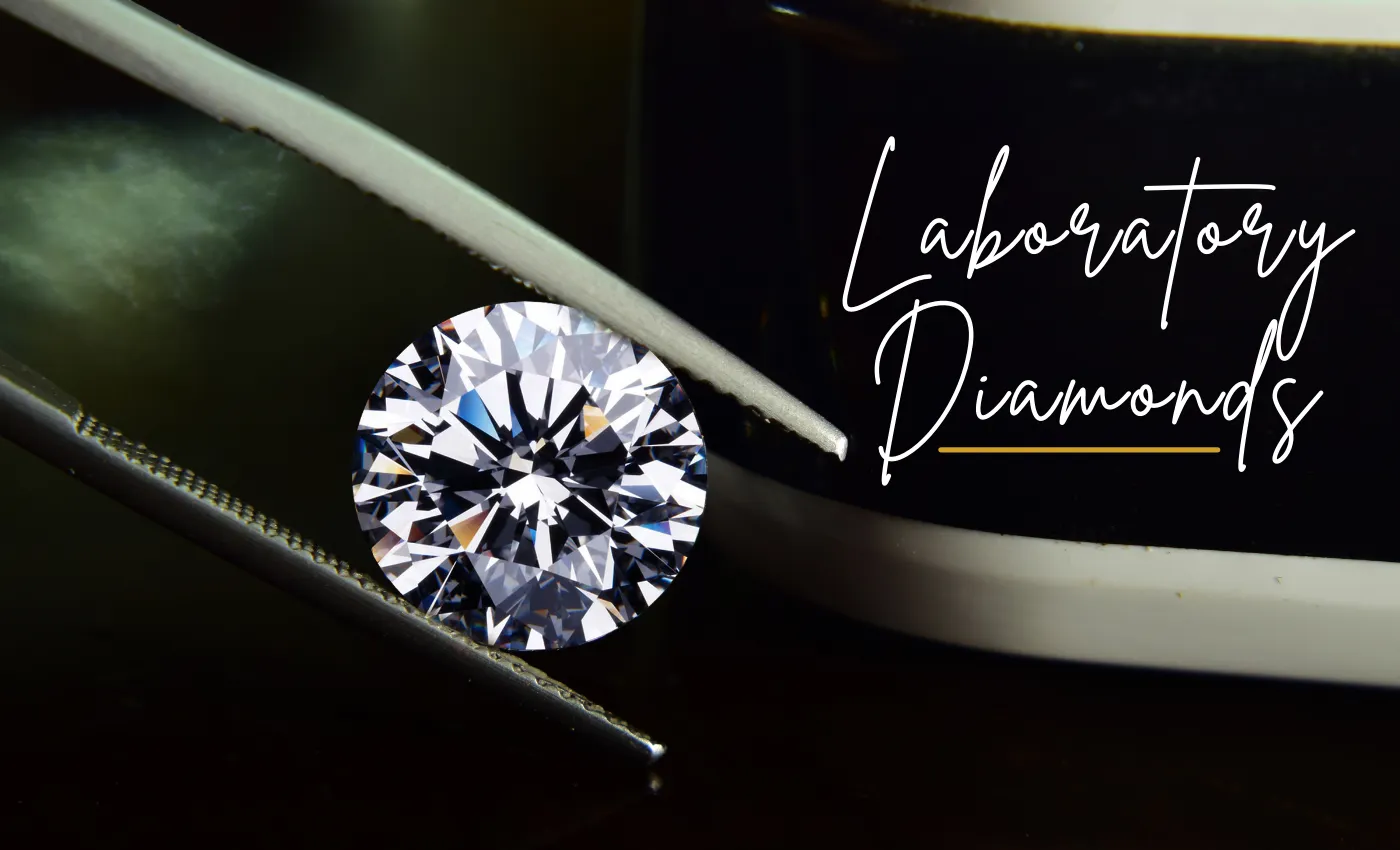
Lab grown diamonds are real diamonds. Chemically, physically, and optically, they are identical to natural diamonds — pure carbon crystallized in a cubic structure, with the same hardness (10 on the Mohs scale), the same dispersion (0.044), and the same refractive index (2.42). The only difference is their origin: lab grown diamonds are created in controlled laboratory environments over a period of weeks or months, while natural diamonds form deep within the earth's mantle over the course of one to three billion years.
The Gemological Institute of America (GIA), the American Gem Society (AGS), and other major gemological authorities all agree: lab grown diamonds meet the scientific definition of "diamond." They are not imitations, they are not "fake," and they are not the same as cubic zirconia or moissanite (more on that below). They are diamonds — just born in a lab rather than the earth.
How Are Lab Grown Diamonds Made?
Two methods produce gem-quality lab grown diamonds today. Both create the same end product but use different processes.
HPHT (High-Pressure, High-Temperature). The original method, developed in the 1950s. Carbon is subjected to extreme heat (over 2,500°F) and pressure (over 870,000 psi), recreating the conditions found deep in the earth's mantle. A small "seed" diamond is placed in molten metal alongside a carbon source, and over the course of several weeks, the carbon dissolves and crystallizes onto the seed, growing a new diamond.
CVD (Chemical Vapor Deposition). The newer, increasingly popular method. A diamond seed is placed in a sealed chamber filled with a hydrocarbon gas mixture (typically methane and hydrogen). The gases are heated to plasma, breaking apart the molecules and depositing carbon atoms layer by layer onto the seed. Over weeks, the diamond grows one atom-thin layer at a time. CVD diamonds tend to grow with cleaner inclusion patterns, and the technology has improved dramatically in the last few years.
Most lab grown diamonds you see in jewelry today are CVD-grown, then sometimes HPHT-treated to enhance color. Both methods produce diamonds that are visually indistinguishable from natural diamonds to the naked eye.
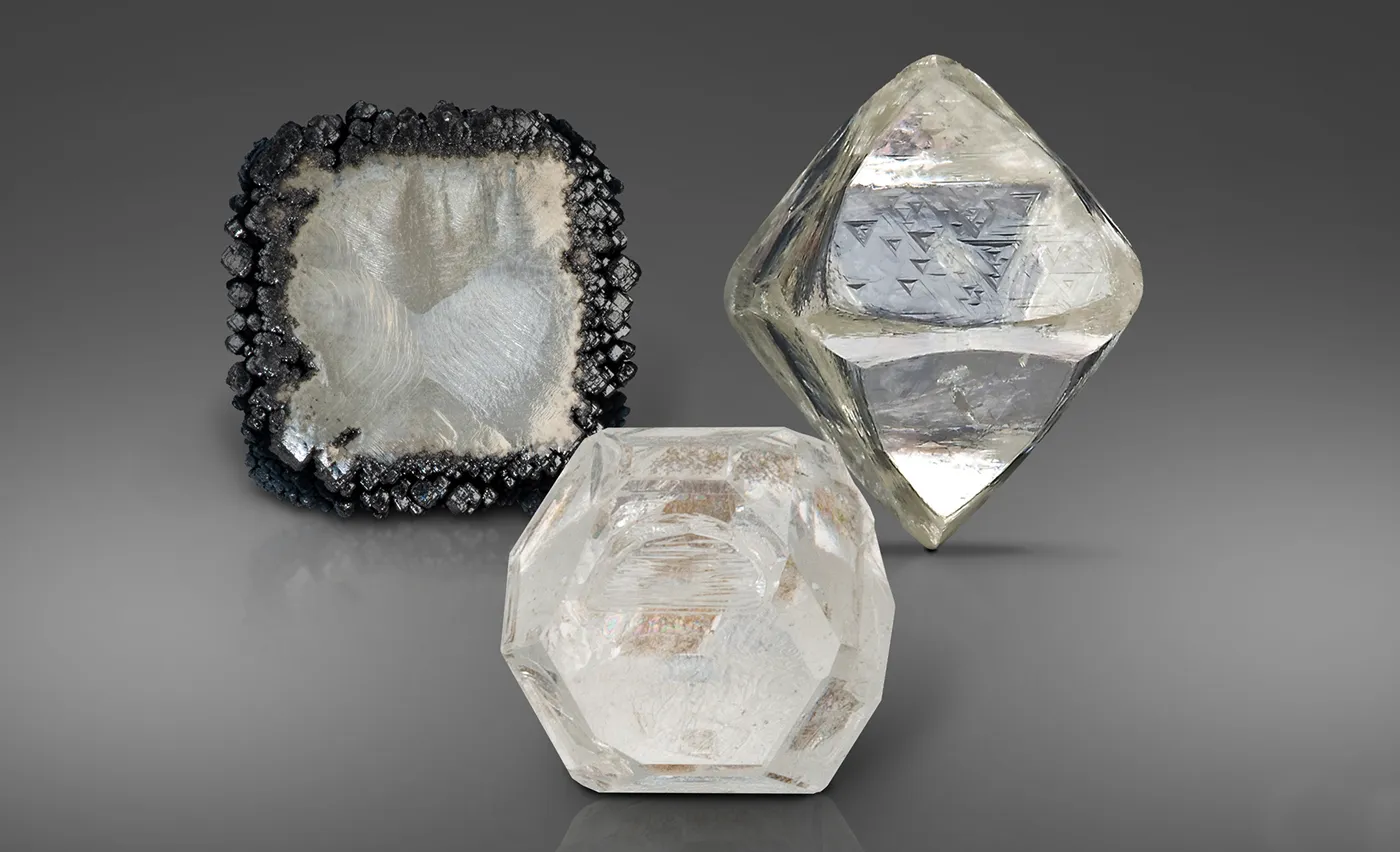
A CVD diamond (left), HPHT diamond (middle), and natural diamond crystal (right). The CVD diamond is edged in carbon from the growth process. (Photo: GIA)
Lab Grown vs. Natural Diamonds: The Real Differences
Both are real diamonds. But the differences matter when you are choosing one for an engagement ring or a major jewelry purchase.
Origin. Natural diamonds formed 1 to 3 billion years ago in the earth's mantle, brought to the surface by ancient volcanic eruptions. Lab grown diamonds are created in a few weeks in a laboratory. For some couples, the natural origin story is meaningful — the romance of "this stone has existed since before life on earth." For others, lab grown's modern origin is part of the appeal.
Visual appearance. Identical to the naked eye. Even gemologists cannot tell the difference without specialized equipment. A 1-carat lab grown diamond and a 1-carat natural diamond, both well-cut and equivalent quality, will sparkle the same way and reflect the same light.
Pricing. This has been the biggest shift in the industry. In 2020, lab grown diamonds cost roughly 30% less than comparable natural diamonds. Today, they often cost 70 to 90% less. A 2-carat lab grown diamond that retails for around $4,000 to $6,000 may cost $25,000 or more in natural form at equivalent quality. The dramatic price drop is largely due to scaled production in India and China and continued improvements in efficiency.
Resale value. Natural diamonds have a long-established secondary market and typically retain 40 to 60% of their original retail value when resold. Lab grown diamonds, by contrast, currently have very limited resale market — the rapid drop in production costs means a lab grown diamond bought new today will likely be worth significantly less in five or ten years if you try to resell it. This is an important consideration if you view an engagement ring as a long-term financial asset versus a personal milestone purchase.
Environmental considerations. Both have environmental footprints. Natural diamond mining involves earth removal, water use, and ecosystem impact. Lab grown diamonds require enormous energy to produce — energy that, depending on where the lab is located, may come from coal, natural gas, or renewables. Neither option is environmentally "free." Couples concerned about environmental impact should research the specific origins of any diamond they purchase.
Sentiment and meaning. Some couples are drawn to the heritage and natural origin of an earth-formed diamond. Others love the modern, technology-driven story of lab grown. There is no universal "right" answer — only what matters most to you and your partner.
Lab Grown vs. Moissanite vs. Cubic Zirconia — A Common Confusion
This is one of the most-asked questions in our showroom: are lab grown diamonds just "fancy CZs"? The answer is a definitive no.
Lab grown diamonds are diamonds. Pure carbon, hardness of 10, identical to natural diamonds in every measurable property except origin.
Moissanite is a separate gemstone made of silicon carbide. It looks similar to a diamond but has different optical properties (more rainbow-colored fire, slightly different sparkle pattern), a hardness of 9.25 (slightly softer than diamond), and is often used as an affordable diamond alternative. Moissanite is real and durable — just not a diamond.
Cubic Zirconia (CZ) is a synthetic gemstone made of zirconium dioxide. It contains zero carbon. CZs can fade, scratch, cloud, and even change color over time. They have a hardness of around 8.5 (significantly softer than diamond) and are typically used for inexpensive fashion jewelry, not fine jewelry.
So while all three look "diamond-like" at first glance, only lab grown diamonds are chemically diamond. Moissanite and CZ are diamond simulants — they imitate the look without sharing the substance.
How Can You Tell a Lab Grown Diamond from a Natural Diamond?
You cannot — not with the naked eye, not with a jeweler's loupe, not with traditional diamond testers (which only distinguish diamond from non-diamond). Identifying a lab grown diamond requires specialized gemological detection equipment that can detect the trace elements and growth patterns unique to lab grown stones.
At SVS Fine Jewelry, our GIA Graduate Gemologists use specialized lab grown diamond detection equipment combined with their training in chemistry, optics, and gemology to make conclusive determinations on a diamond's origin. Every loose diamond that passes through our Oceanside showroom — for sale, evaluation, or appraisal — is verified by our team. If you bring us a diamond and want to confirm whether it is natural or lab grown, we offer testing as part of our appraisal service.
Lab Grown Diamond Grading Reports
All major gemological laboratories now grade lab grown diamonds, though their approaches have evolved.
GIA (Gemological Institute of America) is the most authoritative grading lab in the diamond world — and as of late 2025, GIA fundamentally changed how it grades lab grown stones. GIA replaced its traditional 4Cs grading scale (color, clarity, cut, carat weight) for lab grown diamonds with two broader categories: Premium and Standard. To qualify as Premium, a lab grown diamond must achieve D color, VVS clarity or higher, and Excellent polish and symmetry (round brilliants also need an Excellent cut grade). Standard covers diamonds in the E–J color range with VS clarity, Very Good polish, and Good-or-better symmetry. Diamonds that fall below the Standard minimums no longer receive a GIA assessment. Every assessed stone is laser-inscribed on the girdle with “Laboratory-Grown” and its GIA assessment number. GIA made this change because over 95% of lab grown diamonds submitted for grading now fall within a very narrow color and clarity range — making the natural-diamond 4Cs scale less informative for lab grown stones.
Learn more about GIA’s Laboratory-Grown Diamond Quality Assessment
IGI (International Gemological Institute) is the most common grading authority for lab grown diamonds, particularly those produced in India. IGI reports for lab grown diamonds are visually distinct (yellow report cover) and include "lab-grown" laser-inscribed on the diamond's girdle along with the report number.
Learn more about IGI Lab Grown Reports
AGS (American Gem Society) issues Laboratory Grown Diamond Grading Reports that prefix grades with "LG" to clearly distinguish them from natural diamond grades.
Learn more about AGS Lab Grown Reports
Regardless of which lab issued the report, always insist on a recent grading report from a major laboratory before purchasing any lab grown diamond — especially online. We can help you read and interpret any lab grown report at SVS, whether you are buying or comparing.
Which Diamond is Right for You?
This is the question we help couples answer every day. Here is the framework we use:
- Budget is the top priority — you want maximum size for the money. Lab grown is the clear choice. You can typically get a diamond two to three times larger than a natural diamond at the same budget.
- You view the engagement ring as an heirloom or long-term financial asset. Natural diamonds retain value and have a deeper resale market. Lab grown's resale potential is limited.
- You love the romance of "billions of years in the earth." Natural diamonds carry that origin story.
- You love the idea of cutting-edge science creating something beautiful. Lab grown speaks to that.
- You want a larger center stone with surrounding sparkle accents. Lab grown lets you upgrade size meaningfully without compromising the design.
- You want maximum quality at a moderate size and budget is flexible. Either works — we recommend seeing both side by side.
There is no universal right answer. The right choice depends on what matters to you, your partner, your budget, and your long-term plans for the ring.
Why Choose SVS for Your Diamond — Lab Grown or Natural
SVS Fine Jewelry has been Long Island's premier independent jeweler since 2003. Our founder Sami Saatchi is a GIA Graduate Gemologist, and our team includes a second on-staff GIA Graduate Gemologist & Appraiser, master jewelers and master setters with over 45 combined years at our Oceanside bench, and bridal specialists who have helped thousands of Long Island couples choose between lab grown and natural diamonds.
We carry both. We sell both. We educate honestly about both — and we believe the right choice is the one that is right for you, not the one with the highest margin for the jeweler. Our 4,000+ sq ft Oceanside showroom keeps over 1,000 engagement rings in stock plus loose diamonds in every shape, size, and origin (lab grown and natural). Most importantly, we always recommend seeing diamonds in person — lab reports are essential, but the way a stone moves with the light reveals itself only when you see it across the table from a gemologist.
Visit SVS to Compare Lab Grown and Natural Diamonds in Person
The best way to decide between lab grown and natural is to see them side by side. Book a private bridal appointment in our Oceanside showroom and our team will pull both options at your target size, shape, and quality — under jeweler's lighting, with the same setting style, on your finger.
3323 Long Beach Road, Oceanside, NY 11572
Mon–Wed & Fri–Sat 10am–6pm | Thursday 10am–8pm
(516) 766-2614 | Book a private bridal appointment — save $100
Family-owned in Oceanside since 2003 — with over 2,500 five-star Google reviews. Where Long Island gets engaged.
For more diamond education, explore our complete Diamonds 101 blog series, including our complete diamond shapes guide and other expert resources.
Additional Resources from Industry Authorities
#SVSFineJewelry #LongIslandsPremierJewelryStore #WhereLongIslandGetsEngaged #LabGrownDiamonds #EngagementRings